
Facebook finds it origins in the need-gap of college students, and in the consumer insight that everybody wants to make friends, have a social circle, be known, tell people about themselves…and that the majority of us have considerable difficulty in doing so. A recent article in the WSJ likens Zuckerberg to a primatologist and suggests that Facebook just acts on our primal instincts of intense curiosity and overweening pride.
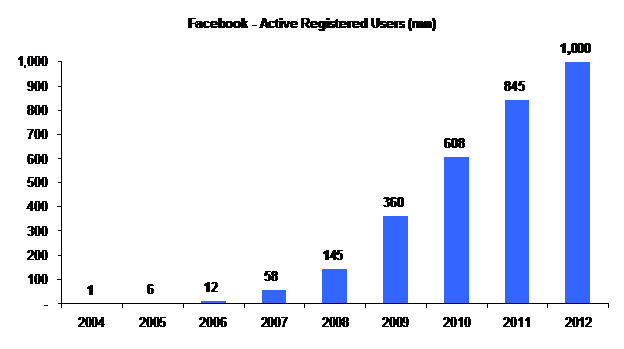
At 900 million users globally – making it the 3rd largest nation – Facebook just completed its $100 bn IPO, so I guess the consumer insight and primal instinct is spot on.
So what happens next? Does Facebook expand indefinitely, till it envelops all 6 billion of us?
There are two distinct possibilities here.
One, personal – At what point does the “social network” that you are part of max out? At what point do you stop inviting new friends into your circle? What started out as your ‘friend-circle’ of 150 has now swelled to 500-3500 depending on where you believe your charm extends to.
It is matter of fact that the average person cannot be friends with more than 150 people. This number comes from the ancient village unit, of the number of people you can meet with and interact with regularly – that is on a daily and weekly basis, relatives included. Take a look at yourself – do you really have more than 150 ‘friends’? As your social network expands, you begin to maintain separate groups – but it is time consuming and hard work to say the least. After a while, it’s not so much fun and most people revert to their cosy circle of 150.
Now – for the company Facebook – they have millions of tiny ecosystems – of groups of friends of populations of 150-500… So when Facebook claims to have 900m subscribers/members, they actually have about 270m individual ecosystems that are run on a common platform – ecosystems which share common apps, features and tech developments, but otherwise exist in relative isolation. Exactly like real life!
So the clever idea is that the Company Facebook can expand indefinitely, as long as it remains cool, relevant and cutting edge – creating millions and millions of tiny ecosystems…even as the ecosystems themselves stop expanding.
What happens next? What will stop Facebook, or replace it? Will it replace itself? There is this mobile tsunami that threatens to engulf us…and most old world media – I never thought I’d refer to Facebook as old world, but anything that has been born on the old pc/laptop screen is old world – needs to reimagine itself completely for the new mobile screen and psychology.
It would be terrible if someone did to Facebook what Apple did to Sony’s Walkman with the iPod – basically take their idea and recast it in a shiny, new avatar. The insights and instincts remain, just the product changes. But then again, that is insight as well – that instinctively, humans – especially college students – are easily bored and always seek change 🙂
 SAMEER NAIR